
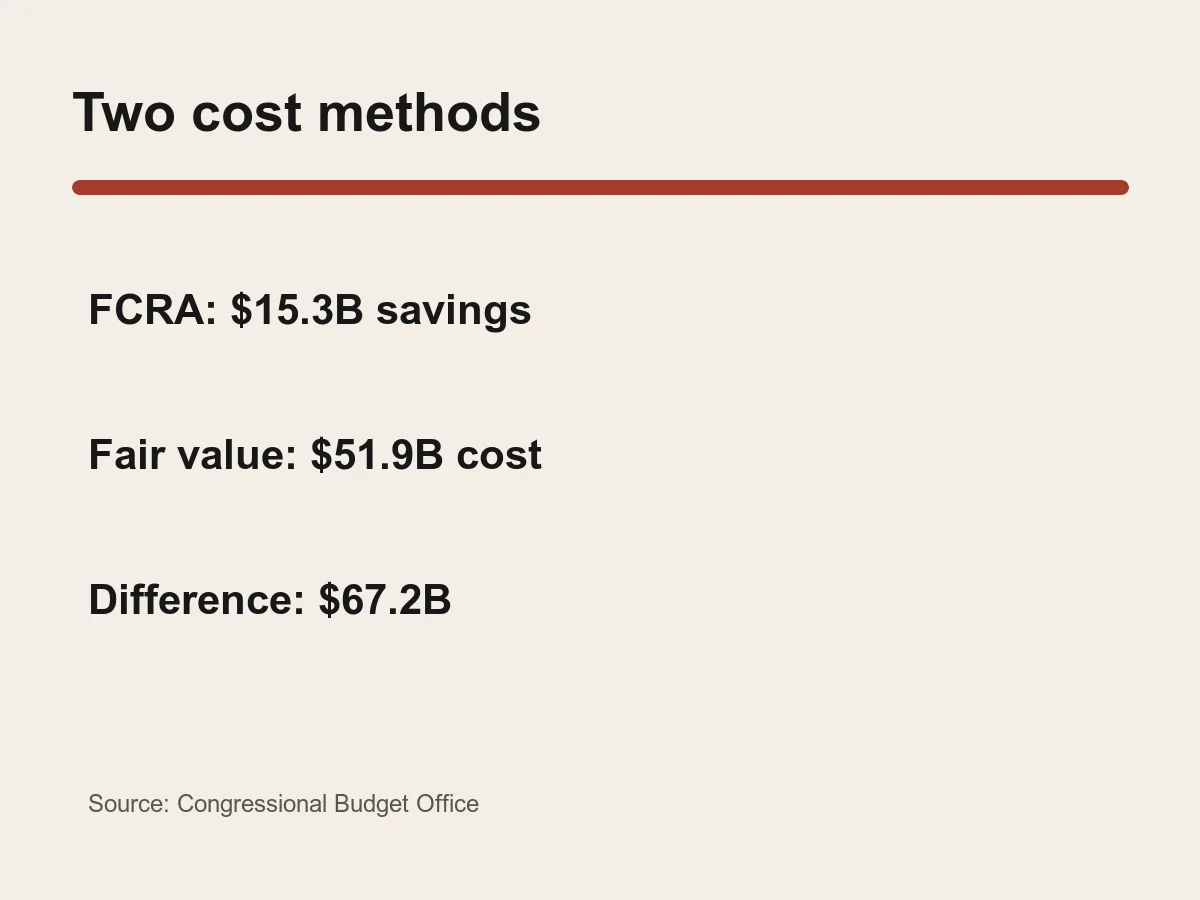
Two methods for measuring the lifetime cost of federal credit programs produce estimates that differ by $67.2 billion for loans and guarantees projected in fiscal 2027, the Congressional Budget Office reported.
Procedures under the Federal Credit Reform Act, the method used in the federal budget, show $15.3 billion in lifetime savings. CBO's fair-value method instead shows a $51.9 billion lifetime cost.
Both estimates use projected cash flows. The fair-value approach adds a market-risk premium, while the FCRA approach discounts projected cash flows using Treasury rates.
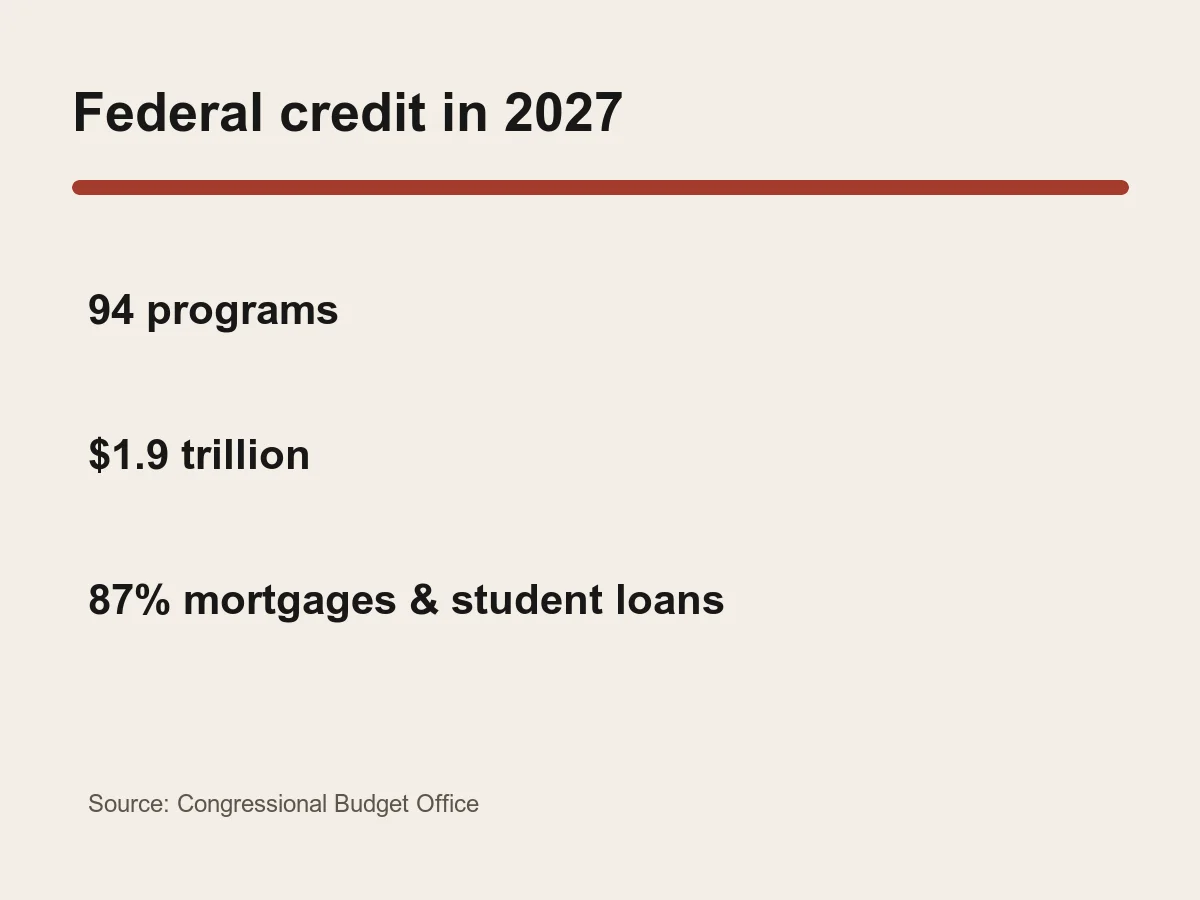
CBO analyzed 94 programs projected to provide $1.9 trillion in credit assistance: $216 billion in direct loans and $1.7 trillion in loan guarantees.
Mortgage guarantees and student loans account for 87% of the total. Fannie Mae and Freddie Mac alone are projected to provide $1 trillion in new mortgage-backed-security guarantees.
Nearly two-thirds of the gap between the methods comes from Fannie and Freddie guarantees, Housing and Urban Development programs, and Department of Education student loans.
For Fannie and Freddie, FCRA shows $12.5 billion in savings while fair value shows a $3.9 billion cost. HUD credit shifts from $8.7 billion in savings to an $8.1 billion cost, and student-loan costs rise from $3.6 billion to $13.7 billion.
The estimates are projections, not current cash balances. Policy changes, updated data, estimating methods, economic conditions and the characteristics of borrowers can all change projected loan volumes and cash flows.
CBO says fair value is more comprehensive for comparing policy trade-offs because it includes market risk, while FCRA remains the statutory budget measure. The $67.2 billion gap describes a measurement choice, not an accounting error.