Federal judges imposed sentences within the applicable guideline range in 19,136 cases during the first half of fiscal 2026, according to preliminary United States Sentencing Commission data.
Those within-range decisions represented 59.1% of 32,390 cases eligible for the comparison. The Commission received 32,586 cases covering Oct. 1, 2025, through March 31, 2026, and excluded 196 from the range table.
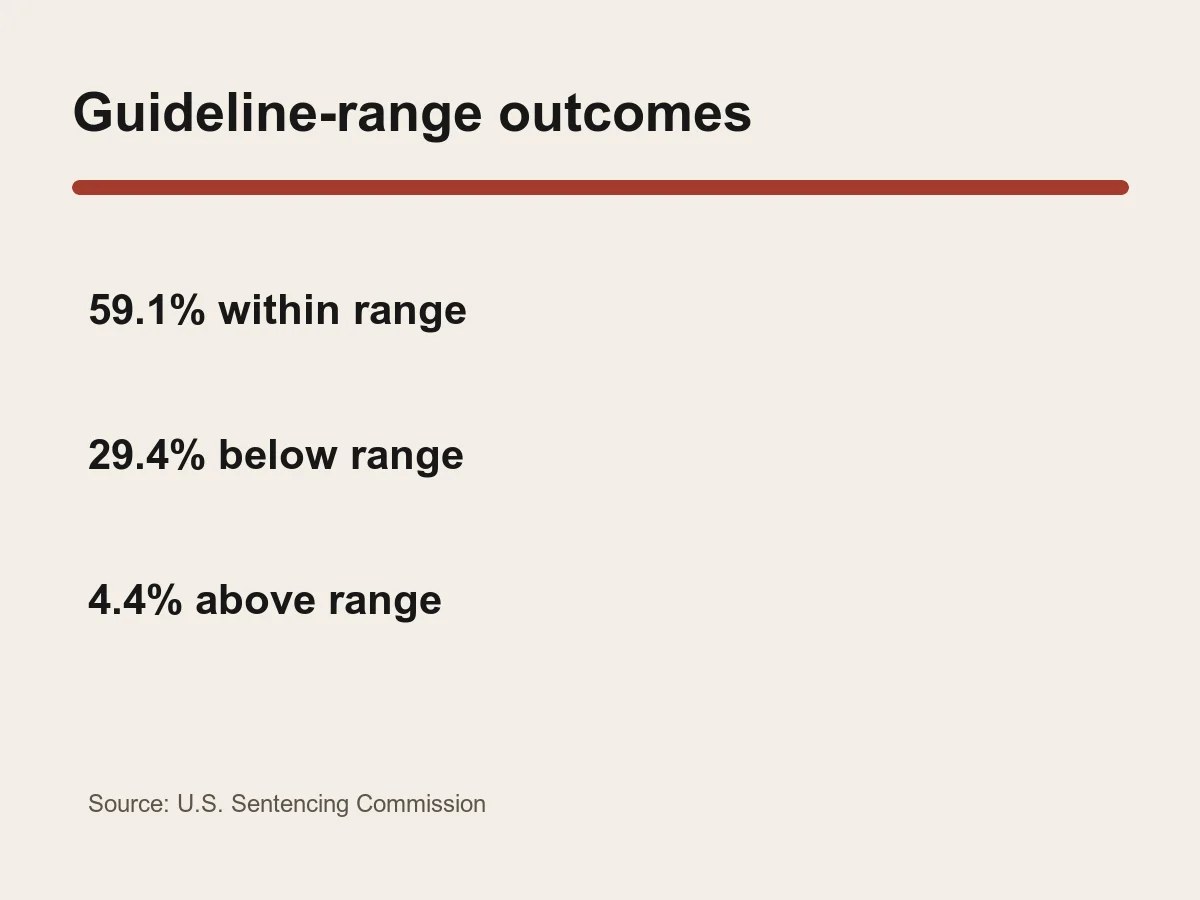
Sentences were below the guideline range without a government motion in 9,537 cases, or 29.4%. Another 2,284 cases, 7.1%, were below range after a government motion for substantial assistance.
Judges imposed above-range sentences in 1,433 cases, or 4.4%. The categories describe the sentence relative to the final guideline range and do not by themselves identify the offense, sentence length or reasons in an individual case.
The update covers cases reported to the Commission by the end of the quarter. Late submissions and later corrections can change the totals before the agency publishes final fiscal-year statistics.
Comparisons with older reports require care because Amendment 836 took effect Nov. 1, 2025. The amendment eliminated guideline departures and created an exceptional-degree-of-mitigation adjustment, changing how some outcomes are classified.

The Commission publishes quarterly tables to show the volume and characteristics of federal sentencing before the annual dataset is complete. The report also breaks cases down by offense, district, demographics and statutory penalties.
The percentages are aggregate judicial outcomes, not a measure of guilt, crime prevalence or the quality of any sentence. Federal sentencing depends on statutes, guideline calculations, criminal history and case-specific findings.
Because the six-month data is preliminary and the category definitions changed during the period, it should not be treated as a final trend line for the full fiscal year.