
Federal financial regulators remain in the early stages of implementing joint data standards required by the Financial Data Transparency Act, the Government Accountability Office said in a May review.
Congress enacted the law in December 2022 to make financial information easier to share and analyze. Regulators were working to finalize an August 2024 proposed rule when GAO completed its review; most agencies must then write their own rules to apply the joint standards.

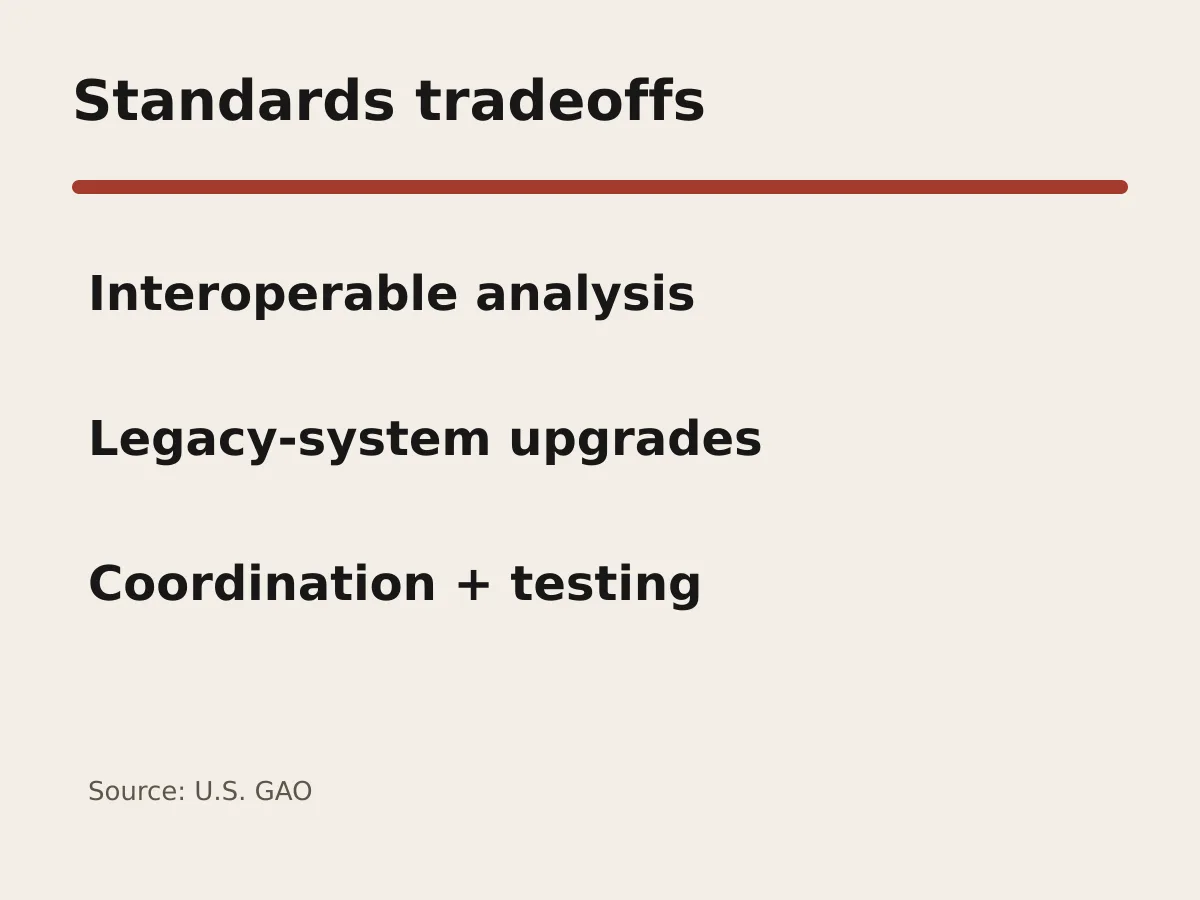
The intended result is more interoperable reporting. Banks, market participants and other entities can be required to submit the same or similar information to multiple agencies, and common data fields could reduce duplication and support automated exchange.
GAO said standardized reporting could improve the quality and efficiency of regulatory analysis, help agencies identify compliance concerns sooner and reduce filing burdens across multiple regulators.
Those gains are not automatic. Agencies may need to modernize legacy systems, coordinate technical decisions and establish durable data-governance policies. Reporting entities may face costs to change software, business processes and testing programs.
The watchdog reviewed records and corresponded with officials from nine financial regulatory agencies. It also spoke with four practitioner groups, four groups representing reporting entities and two academic researchers.
Some stakeholders see the law as a possible foundation for a broader system known as Standard Business Reporting, in which a government-wide taxonomy lets data move automatically between reporting entities and agencies. The United States does not currently have such a system.
GAO did not estimate a net dollar benefit or say that implementation is complete. Its report describes a sequence of rulemaking and systems work whose costs and results will depend on choices that regulators and filers have not yet finished.
The near-term test is therefore practical: whether agencies can agree on usable standards, govern them consistently and implement them without replacing duplicate paperwork with incompatible technical systems.