
The Government Accountability Office has published a four-pillar framework for measuring U.S. artificial-intelligence competitiveness, an attempt to make broad claims about the global AI race more systematic and testable.
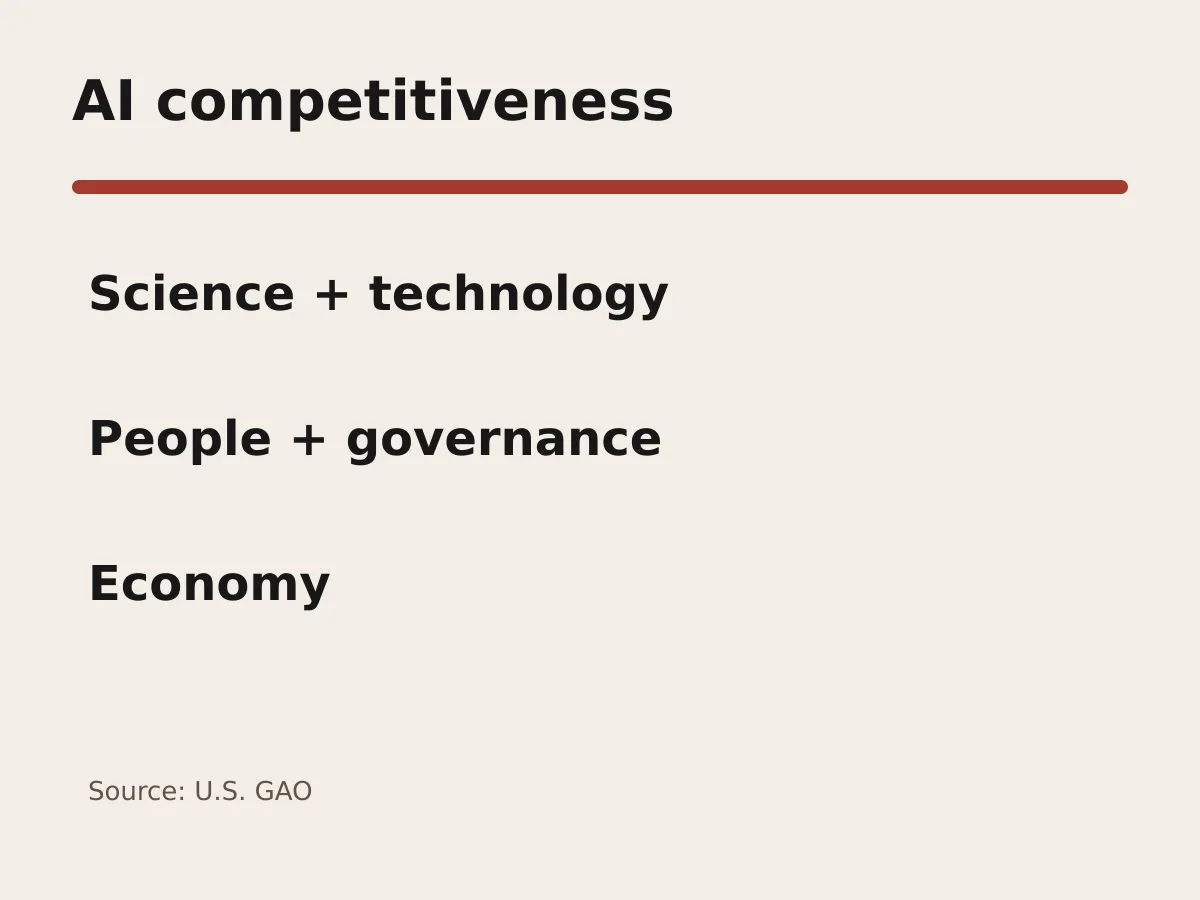
The pillars are science and technology, human capital, governance and the economy. Each includes subpillars such as research and development, workforce, laws and policies, infrastructure, investment and financing.
GAO says an assessment should begin by selecting the outcome policymakers care about. An analysis focused on exporting AI technology, for example, may use different indicators than one focused on research leadership or standards influence.
Analysts then identify indicators, conduct data analysis and develop policy options. The method can compare the United States with other countries or track U.S. capabilities over time.
The report does not produce a single U.S. score or declare a winner in the AI competition. It provides a structure for choosing evidence and explaining why particular metrics are relevant.
GAO developed the framework through literature review and consultation with experts from government, academia, industry and nonprofit organizations. It is designed for analysts in any of those sectors.

The office notes that AI competitiveness involves trade-offs. Computing infrastructure, talent and investment can accelerate development, while deployment also creates risks involving jobs, energy use, safety and governance.
Rankings produced with the framework will still depend on indicator quality, weights, available international data and the chosen outcome. Different defensible choices can yield different results and should be disclosed.
The practical contribution is a common checklist: national AI strength cannot be reduced to model performance or private investment alone, and policy comparisons should account for the institutions, people and economy around the technology.