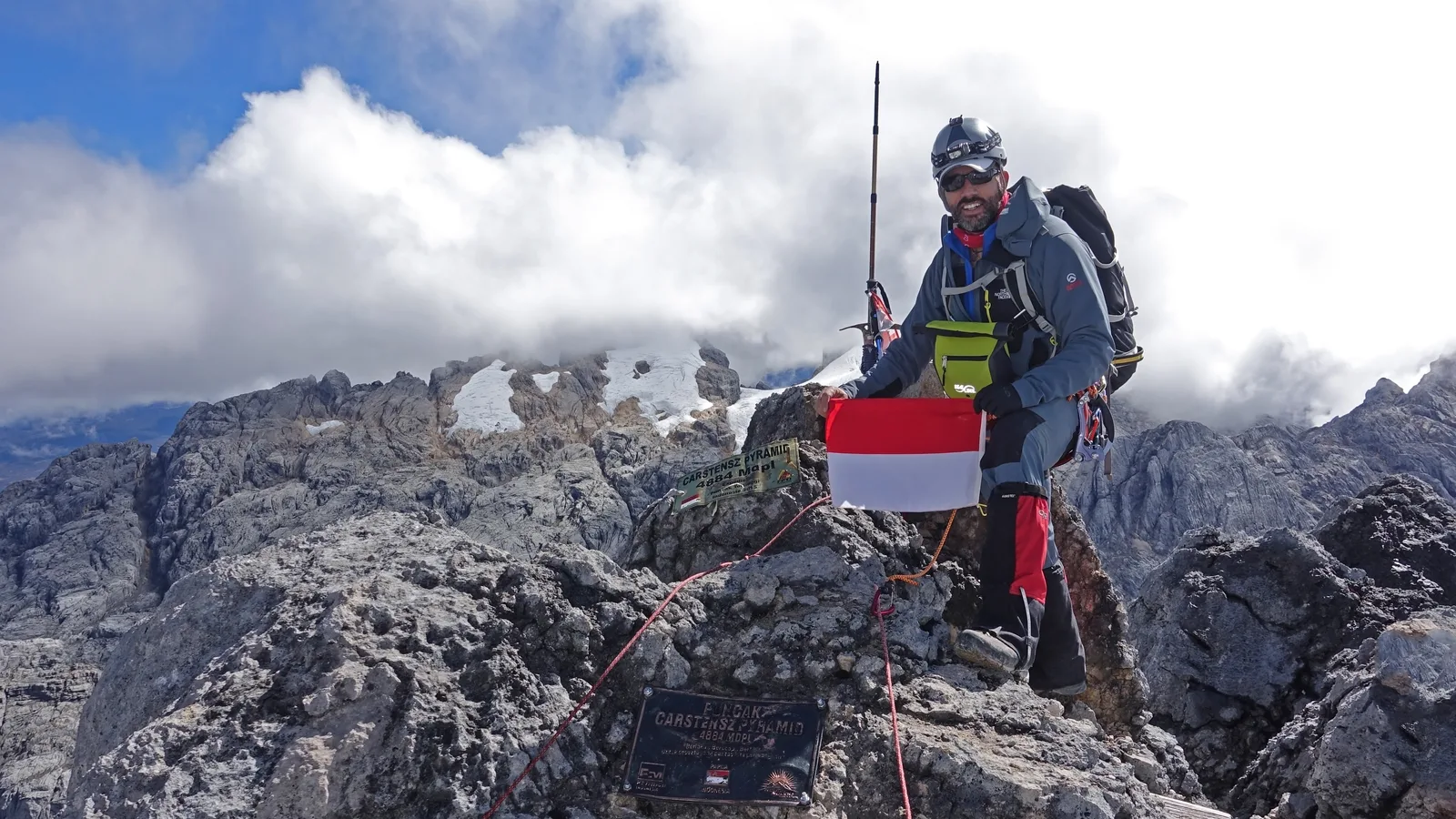
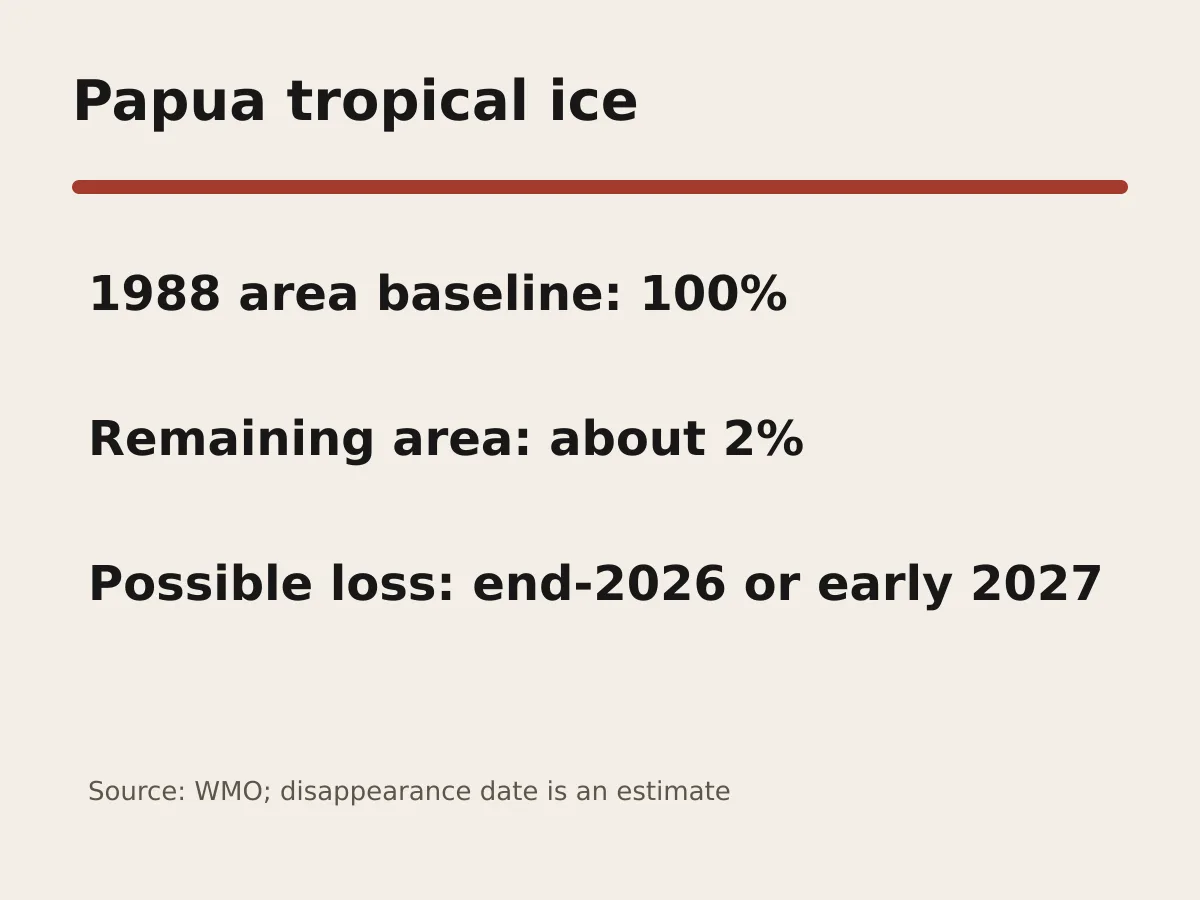
Papua's remaining tropical glacier ice could disappear by the end of 2026 or early 2027, the World Meteorological Organization says, after shrinking to about 2% of the area measured in 1988.
The estimate appears in WMO's State of the Climate in the South-West Pacific 2025 report. The date is a scientific expectation rather than a precise prediction of the final day on which ice will remain.
Tropical glaciers persist at high elevation despite warm surrounding climates. Their small size makes them especially sensitive to sustained warming and changes in snowfall, cloud cover and surface energy.
WMO says 2025 was the South-West Pacific's second-warmest year on record, about 0.37 degrees Celsius above the 1991–2020 average. The comparison uses a regional baseline and should not be confused with global warming since the preindustrial era.
Marine heatwaves affected almost the entire ocean area covered by the report and were the most extensive observed in a year without El Niño, according to WMO.
Regional mean sea level rose 3.7 millimeters per year, with a stated uncertainty of plus or minus 0.03 millimeter, from 1999 through 2025. Local coastal change can differ from that regional average because of land motion, currents and weather.

WMO also reports record-low surface-ocean pH across nearly the whole region, consistent with ongoing ocean acidification. The measure describes seawater chemistry, not a uniform condition at every depth or location.
The glacier projection and ocean indicators are related signs of a warming climate, but they arise from different physical systems and observation methods. The report does not attribute every local event to a single cause.
Continued satellite and field observations will determine whether the last ice persists beyond the stated window. WMO's report makes the uncertainty explicit by giving a range that spans two calendar years.